Michelle Russo ’87
The Story
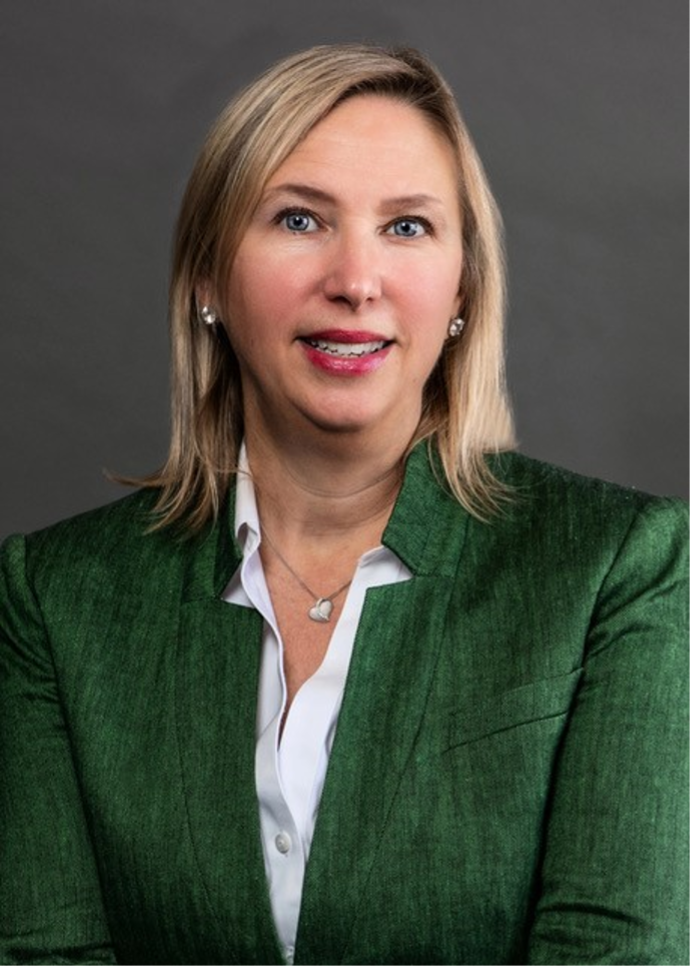
Founder & CEO, hotelAVE (Hotel Asset Value Enhancement, Inc)
Michelle’s resume is impressive, but stick around for the Q&A below. Michelle gets into orange roofs, cruising in her Jetta in search of roadside motels, and the lawsuit that helped invent hotel asset management as we know it.
Michelle is a recognized hotel industry leader with 40 years of hospitality real estate expertise. A distinguished member of the Cornell Class of 1987, Michelle exemplifies excellence in the hospitality industry, making her a deserving candidate for induction into the Cornell Hotel Society Hall of Fame. In 2003, Michelle founded Hotel Asset Value Enhancement, America’s leading hotel owner, advisor and asset management firm, with over 85 hotels and $12.5 billion in AUM. The firm advises on an additional $10 billion of hotel real estate annually and has a legacy of unrivaled performance for $160 billion of hotel real estate value. hotelAVE delivers value and insightful advice to partners, owners, and clients to help maximize an asset’s performance through a combination of expertise, market knowledge, proprietary data, and analytics.
Michelle oversees the practice and is very involved in defining the forward outlook that establishes how the company manages its portfolio to maximize results, strategic asset positioning, management contract negotiations, and interacting with senior-level brand and management executives on behalf of the portfolio. Under Michelle’s leadership, hotelAVE has become a prominent player in hospitality asset management. Her innovative strategies and visionary insights have not only driven the company’s success but have also set new standards in the industry.
Michelle is an ALIS Award Winner, named Jack A. Shaffer Financial Advisor of the Year 2021 and (UMass) Isenberg HTM’s Distinguished Industry Leader in 2025. She has been named one of the 30 Influential Women in Hospitality by Hotel Management Magazine (2017), one of 20 Women in Lodging by Lodging Magazine (2015) and one of 15 Women of Hospitality Finance by Hospitality Financial and Technology Professionals (HFTP).
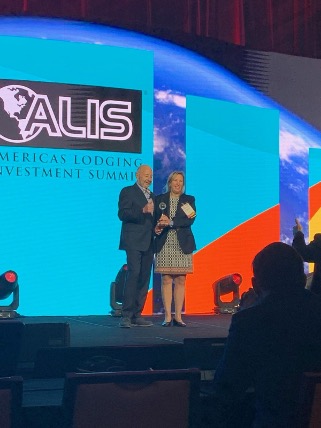
Michelle receiving the Jack A. Shaffer Financial Advisor of the Year awards in 2021
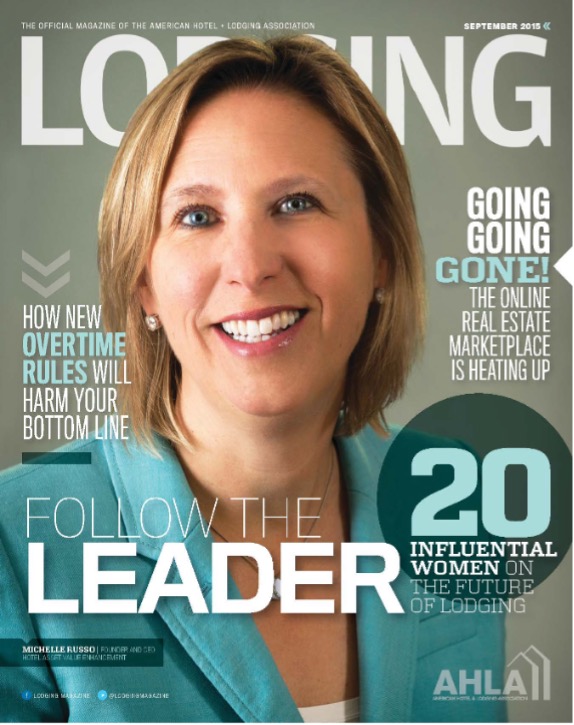
Michelle Russo on the cover of the 2015 Lodging Magazine in which she was named one of 20 Influential Women in Lodging
Prior to founding hotelAVE, Michelle was Vice President, Senior Leisure Analyst for Deutsche Banc Alex Brown where she garnered capital markets experience covering lodging and leisure (including cruise, ski and golf industries). Michelle also managed a $500M portfolio for John Hancock Mutual Life Insurance Company where she improved the portfolio and achieved 20% cash-on-cash returns.
Michelle is a regular guest speaker at many university and industry conferences and has appeared on CNBC and CNN. Michelle serves on the AHLA’s Hospitality Investment Roundtable, and AHLA’s Global Finance Committee. She is a former board member of Morgans Hotel Group and former member of ULI’s Hotel Council, Marriott’s Distribution Strategy Advisory Committee, and the Pillsbury Institute for Hospitality Entrepreneurship at Cornell University. She is also a two-time past president of the Hospitality Asset Manager Association (HAMA), a Certified Hotel Asset Manager (CHAM), Certified Hotel Administrator (CHA) and a Member of the Appraisal Institute (MAI).
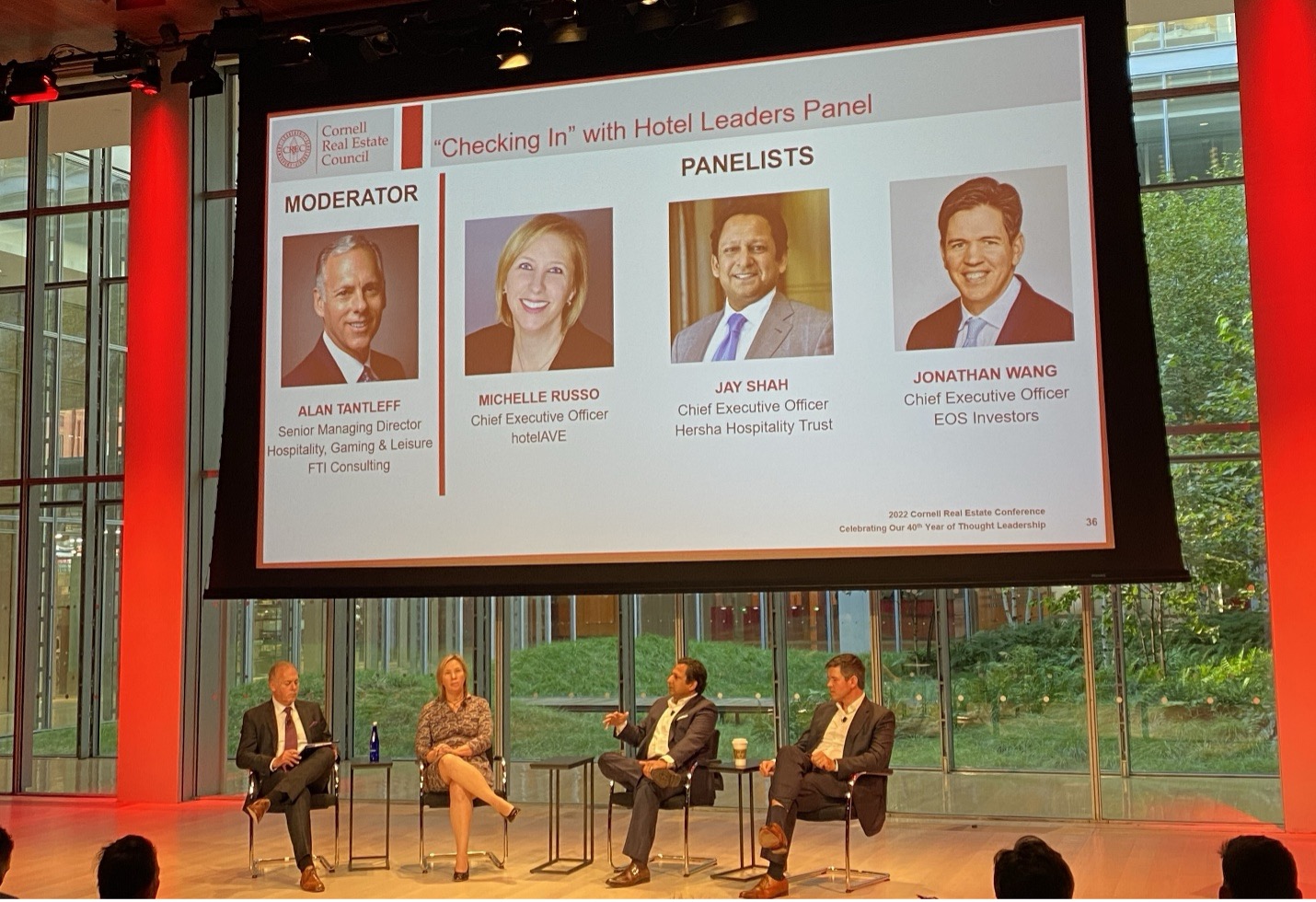
Michelle Russo speaking at Cornell RE Event 2022
As a former member of the Dean’s Advisory Board for Cornell University’s School of Hotel Administration, the Cornell SC Johnson College of Business Leadership Council, her guest speaker engagements and contributions to the eCornell Hotel RE Investments and Asset Management Certificate program, Michelle contributes greatly to Cornell’s hospitality education. Her involvement has expanded to support University of Massachusetts and University of Denver’s hospitality programs to ensure that academic curriculums remain relevant and aligned with industry needs, demonstrating her commitment to nurturing the next generation of hospitality leaders. Michelle is also a passionate advocate for diversity and inclusion within the hospitality field. Through mentorship programs and initiatives, she empowers aspiring professionals, particularly women, to thrive in a traditionally male-dominated industry. Michelle’s journey from Cornell to becoming a leading figure in hospitality serves as an inspiration to current students and alumni alike. Her dedication to excellence, combined with her philanthropic efforts, reinforces the values and traditions of the Cornell Hotel Society.
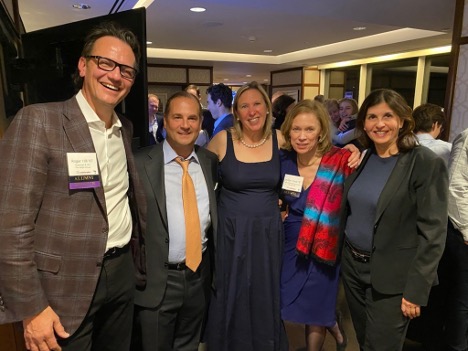
Michelle attending HEC with her 1987 classmates: Roger Hill, Tony Capuano, Jackie McFadden, and Mari Garcia
Q&A with Michelle
How did you get interested in hospitality?
I grew up under orange roofs. My Dad spent his early career (until I was 18) with Howard Johnson’s, starting as an assistant manager trainee and working his way up to president of restaurants and lodging. Howard Johnsons was bigger than Marriott when I was growing up. Hospitality was dinner-table conversation in our house every single night and if I wanted to spend time with my Dad, I would go to work with him and help him do month end inventory.
My dad brought me to dinner at a co-workers house (Tom Pedulla, Cornell 1960) to talk about schools with hospitality programs. The dining room table was decorated with HEC plates. That sealed it. I applied to hospitality schools and ultimately attended Cornell.
Who was one of your biggest influences in your career?
Besides my Dad, it would be Professor Jim Eyster ‘69 (a Hotelie Hall of Fame inductee in 2023) – my professor and boss in college. From him I realized I liked the numbers, the analytics, and the way data could tell a story. Professor Eyster taught me a lesson I still use today: financial analysis often requires you to make good assumptions backed up by data, because in the real world all the drivers or data you’d like to have are never fully available.
How did you get into asset management?
It started when John Hancock hired me in the mid-1990s to help run their $500 million hotel portfolio, and it was the first time I got to execute decisions and apply drivers of valuation to create portfolio value rather than just make recommendations.
In the mid-1990s most hotels were owned by the brands or co-owned between a brand and an insurance company. Think before REITs. Hotel asset management was in its infancy and I was at its forefront and therefore able to very much influence what hotel asset management is today. In fact, I am the only hotel asset manager to receive the Jack A Shaffer Financial Advisor of the Year award presented annually at ALIS that recognizes top-tier dealmaking, leadership and relationship building in hospitality investment banking and financial advisory. For me that recognition is also a recognition of finding my passion.
When I started in asset management, there were a handful of other insurance companies that also had hotel asset managers. I was one of the first and we were all learning together. When I first started, there was also a group called Hospitality Asset Manager Association (or HAMA). For them, it was a forum to vent about how management companies were making money while the owners were funding operating losses and their frustration of the misalignment of interests. By the middle of the 1990s, the economy picked up and their association purpose was concluded – hotels were making money again. They were disbanding the organization. Instead, I asked to take it over and was handed a shoe box with a check book and a copy of the by-laws. I started over from scratch re-founding HAMA which is today the industry’s largest worldwide association for hotel owners today.
The defining project for me at John Hancock was a lawsuit against ITT Sheraton over mismanagement of the Sheraton Washington (then the Marriott Wardman Park) in Washington, DC. It took four years of head-butting before we finally sued to terminate the contract, won the right in court, and were literally a day away from signing with Westin when Westin announced its merger with Sheraton to form Starwood. John Marriott called shortly after asking to be reconsidered, and Hancock ultimately hired Marriott, with the courts awarding Hancock $52 million in damages. It taught me, in the most concrete way possible, that in hotel real estate everything comes down to value, and that value is created or destroyed at every single phase of ownership.
How did you start your own business?
First, I didn’t realize I found my passion as an asset manager who creates hotel real estate value until after I left it. It was when I worked at Deutsche Bank as an equity research analyst covering lodging and leisure stocks that I realized my time at John Hancock never felt like a job. So I quit my Deutsche Bank job and was not quite sure what I was going to do but had enough money saved that I knew I had a year to figure it out.
I moved to Rhode Island, and spent a summer figuring out what came next. I drove around New England in my Jetta looking at small roadside motels I might be able to afford, and came uncomfortably close to buying one, before realizing I’d probably end up living there as an innkeeper. Around the same time, a broker introduced me to owners who needed help improving cash flow, and Lee Pillsbury ‘69, CEO of Thayer Lodging Group (and 2023 Hotelie Hall of Fame inductee), called about a problem asset his firm had run out of ideas for. Those two things, more than any grand plan, launched hotelAVE in 2003. I rented office space in a former daycare center (one of the toilets was about six inches off the ground), hired two people, and started building a track record one hotel at a time. Growth came almost entirely through word of mouth and client referrals.
Why did you start your own business?
After I left Deutsche Bank, I definitely interviewed to work for other people in a hotel asset manager capacity. However, none of the opportunities felt like a step up from what I had done at John Hancock from a responsibility or leadership standpoint. I guess I believed in myself more than others did.
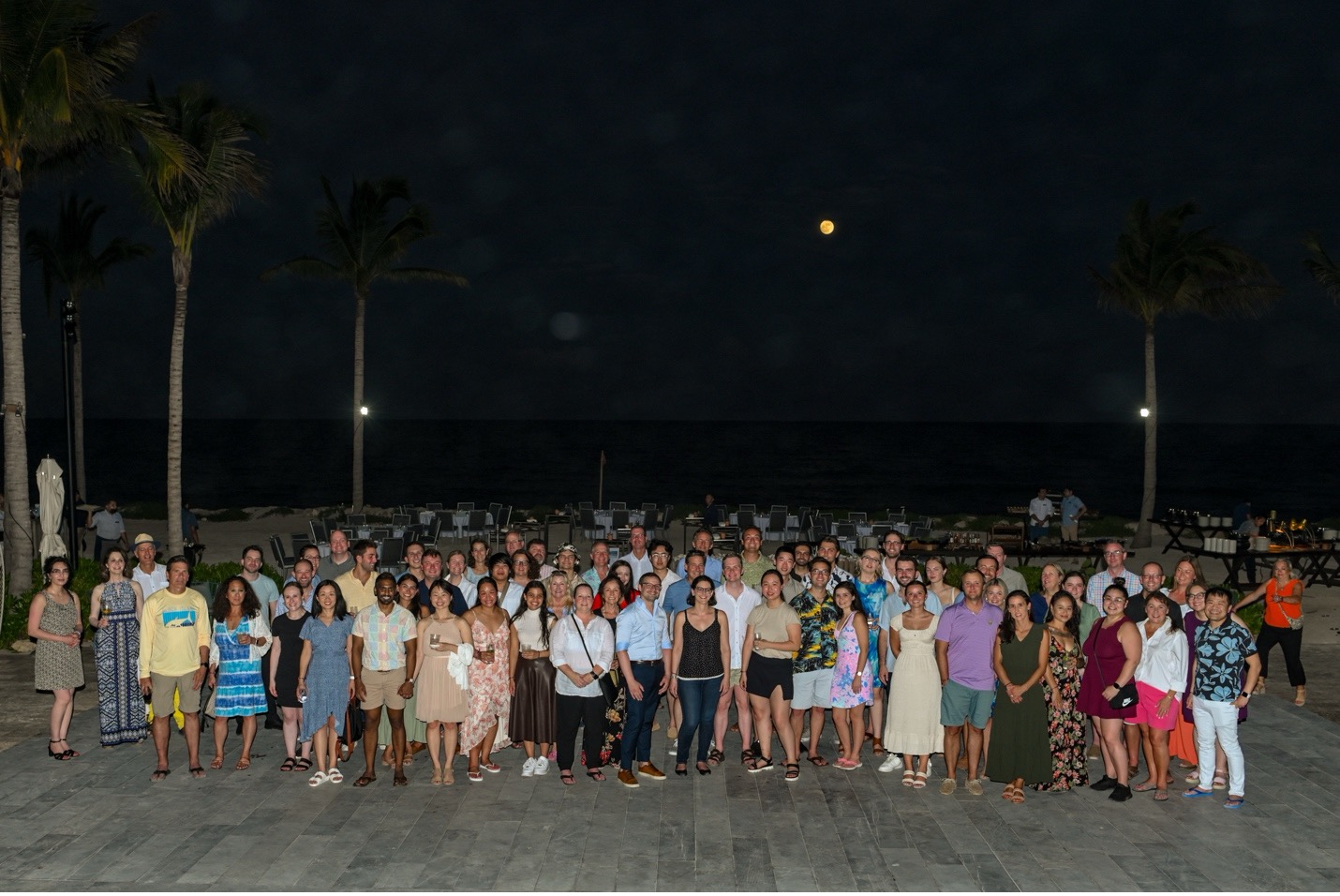
The hotelAVE team celebrating the company’s 20th anniversary at their annual company-wide retreat in Tulum, Mexico
Do you have a mentor?
I don’t have one formal mentor; I’ve always leaned on a circle of people I trust — former bosses, industry peers, and especially my father, who has been my sounding board for nearly every major decision I’ve made in business. My first boss at HVS, Steve Rushmore ‘67, (and 2023 Hotelie Hall of Fame inductee) made a point of bringing junior people into every client meeting, and that shaped how I lead today: if everyone’s included, everyone has context, and everyone has buy-in.
What is your approach to managing and developing talent?
I’ve hired over 250 members of the Cornell Hotel School. My first boss at HVS, Steve Rushmore ‘67, (and 2023 Hotelie Hall of Fame inductee) made a point of bringing junior people into every client meeting, and that shaped how I lead today: if everyone’s included, everyone has context, and everyone has buy-in. I also espouse to the book “Drive” which speaks to autonomy, mastery and purpose – the three elements of motivation.
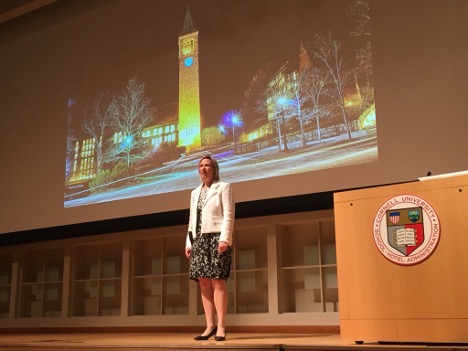
Michelle Russo speaking at Cornell Dean’s Distinguished Lecture Series
How do you balance work and family (a question only ever asked to women)
Balancing a growing company with a family including three boys never happens perfectly and there were missed school events because I was building hotelAVE. A great spouse and support are a must-have. I read a line once about making sure your head and your heart are where your feet are, and it’s stuck with me for twenty years: when I’m home, I’m all in as a mom; when I’m at work, I’m all in there too.
I am proud of my family and the fact that one of my sons chose to follow in my Dad and my footsteps as a hospitality and business major at UNLV.
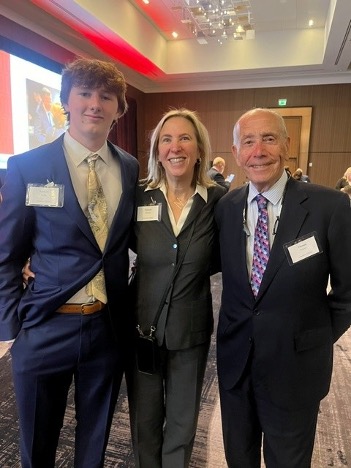
Michelle with her father Tom Russo and son Emmett Rollo at the UMass Isenberg Annual Awards Dinner where she was named HTM’s Distinguished Industry Leader in 2025
What advice would you give your 21 year old self?
If I could talk to my 21-year-old self, a newly minted member of the Cornell Hotel Society, I’d tell her to find her passion sooner, not the job that looks impressive, but the one where the time disappears, and to trust that hard work and integrity pay off, just maybe not on the timeline you’d like.
As a woman who spent most of her career being the only one in the room, I would also tell myself to separate the issue from the emotion, to show up prepared with facts, and to ask, “what would I tell someone else to do here?” and then do that. My advice to younger women in the industry is simple: think about what you’d say if you were a man, and then just say it. Being direct and prepared isn’t aggressive. It’s confident
Everything else, the mentors, the breaks, the Cornell Hotel Society connections that showed up again and again over four decades, I only really understood by looking in the rearview mirror. It wasn’t obvious while it was happening. I’m deeply grateful to the Cornell Hotel Society and to this community for a career I still don’t take for granted.
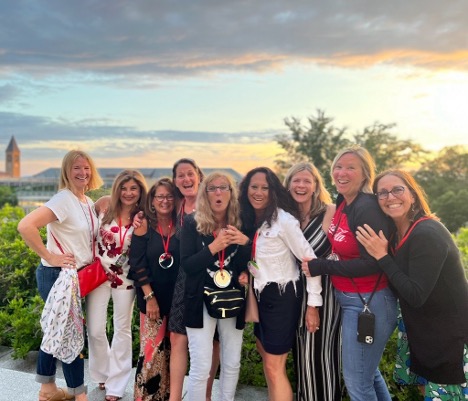
Michelle and classmates at the 35th Reunion at Cornell.